When the Ordinary Becomes Eternal: Reimagining Everyday Life Through Lines and Silence
By stripping away visual excess, Dr. Sinha invites viewers to engage more deeply with the artwork. The absence of colour shifts the focus from appearance to essence, compelling the audience to interpret rather than simply observe.
Aishmita Manna | Kolkata | June 8, 2026 4:39 pm
Photo: SNS
At Sunayani Chitrashala, Dr. Subimalendu Bikas Sinha transforms fleeting moments of daily life into profound artistic expressions, inviting viewers to look beyond the visible and feel the essence of existence.
A Quiet Beginning to a Powerful Exhibition
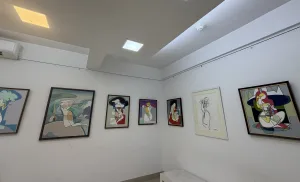
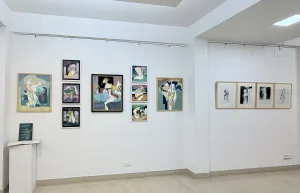
At Sunayani Chitrashala, Charubasana, a remarkable artistic journey unfolded with the inauguration of a solo exhibition of drawings and paintings by Dr. Subimalendu Bikas Sinha.
Advertisement
The exhibition, inaugurated by Prof. Biswatosh Sengupta, former Professor of Information Technology and Vice Principal at B. P. Poddar Institute of Management and Technology marks not just a display of artworks, but a deep engagement with the philosophy of art itself.
Advertisement
Organized by the Indian Society for Art and Aesthetics, the exhibition brought together an audience eager to witness a body of work that challenges conventional ways of seeing and understanding art.
Photo: SNS
The Art of Seeing the Unseen
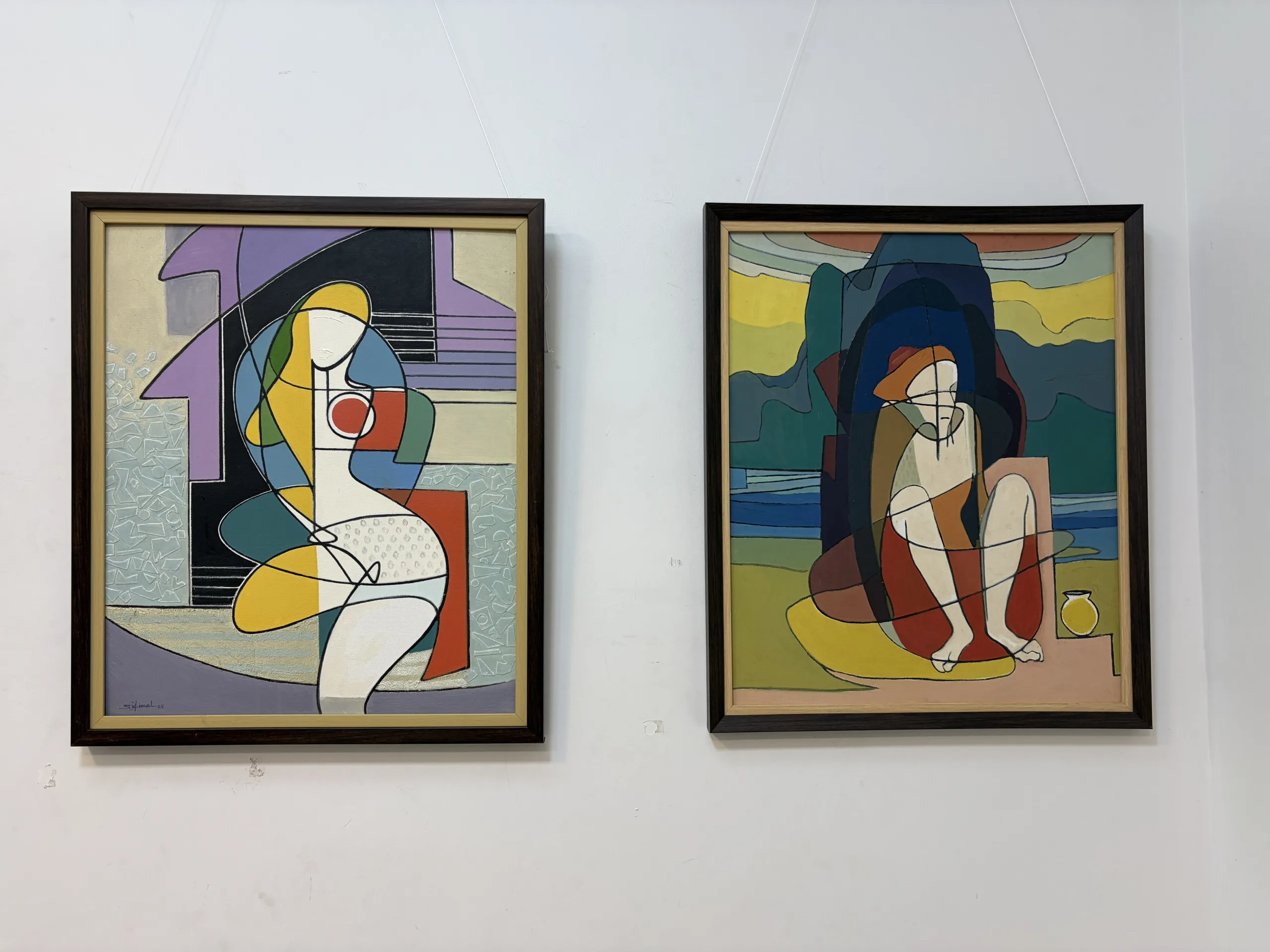
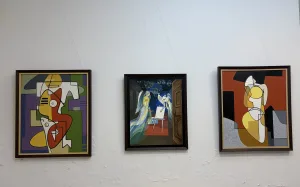
At first glance, Dr. Sinha’s works may appear deceptively simple. There are no overwhelming colours, no excessive ornamentation, only lines, forms, and a quiet intensity. Yet, within these minimal elements lies a profound attempt to capture what often escapes attention in everyday life.
The central idea of the exhibition revolves around the transformation of ordinary moments into extraordinary expressions. Life, as the artist suggests, moves ceaselessly, carrying within it countless unspoken emotions and fleeting realizations. These moments so often overlooked find permanence on canvas. Rather than focusing on grand narratives or dramatic themes, Dr. Sinha turns inward, drawing from the subtle rhythms of daily existence. A gesture, a pause, a silent exchange these become the core of his artistic language. In doing so, he elevates the mundane into something timeless.
Photo: SNS
Woman as the Axis of Life and Imagination
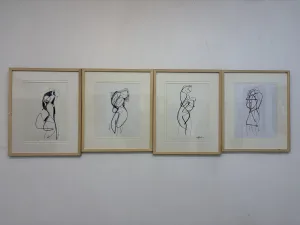
A striking feature of the exhibition is the recurring presence of the female form. However, these representations go far beyond physical depiction. For Dr. Sinha, woman is not merely a subject but a symbol of creation, continuity, and emotional depth. She is portrayed as the foundation of the home and the universe, embodying love, sacrifice, resilience, and transformation. From nurturing life to shaping relationships, her presence is felt in every aspect of existence. Each figure, though structurally similar, carries a unique individuality, reflecting the infinite diversity of womanhood.
This perspective resonates with the poetic vision of Rabindranath Tagore, whose words echo through the exhibition’s thematic core. Tagore’s idea of woman as “half imagination” finds visual expression in these works, where reality and abstraction merge seamlessly. Through delicate yet dynamic lines, Dr. Sinha captures not just the form but the essence of woman: her strength, her vulnerability, and her enduring influence on human life.
Photo: SNS
Lines as Language: A Departure from Convention
One of the most distinctive aspects of the exhibition is the artist’s deliberate rejection of conventional elements such as colour, tone, and spatial realism. Instead, he prioritizes line as the primary medium of expression. These lines move with a certain urgency almost like a sudden flash of thought attempting to transcend sensory limitations. They do not merely outline figures; they evoke emotion, movement, and rhythm.
By stripping away visual excess, Dr. Sinha invites viewers to engage more deeply with the artwork. The absence of colour shifts the focus from appearance to essence, compelling the audience to interpret rather than simply observe. This approach reflects a conscious effort to bridge the gap between creation and perception a gap that, as the artist and the organizers suggest, continues to exist in society.
Photo: SNS
The Distance Between Art and Understanding
While art has been an integral part of human existence for tens of thousands of years, its appreciation often remains limited. The reason, as highlighted by the Indian Society for Art and Aesthetics, lies in the difference between practical life awareness and creative engagement. Society tends to approach art through information and external analysis, whereas true understanding requires emotional and aesthetic sensitivity.
Too often, art is explained rather than experienced. Critics and viewers alike focus on form, technique, or historical context, overlooking the deeper content the feeling that the artwork seeks to convey. Dr. Sinha’s exhibition challenges this tendency. His works resist easy interpretation, encouraging viewers to move beyond words and engage with the silent language of art.
Art as Everyday Awareness
Established in Kolkata in 1996, the Indian Society for Art and Aesthetics has been working to cultivate this very awareness. Through courses, discussions, and exhibitions, the organization aims to integrate aesthetic understanding into daily life.
This exhibition becomes a natural extension of that mission. It is not just about showcasing art but about reshaping perception teaching viewers to find meaning in the ordinary and beauty in the overlooked. In a world driven by speed and information, such an approach feels almost radical. It asks for pause, reflection, and a willingness to see beyond the obvious.
Ultimately, what makes this exhibition compelling is its quiet insistence on returning to the moment. In the rush of modern life, moments slip away unnoticed. Dr. Sinha’s work captures these fleeting instances and gives them permanence. His paintings do not demand attention; they invite it. They do not overwhelm; they resonate. And in that subtle resonance lays their power. By transforming everyday experiences into artistic expressions, the exhibition reminds us that art is not separate from life, it is embedded within it. The ordinary, when seen with sensitivity, holds within it the potential for the extraordinary.
As visitors walk through the gallery, they are not just observing artworks they are participating in a process of rediscovery. Each piece becomes a mirror, reflecting not just the artist’s vision but the viewer’s own capacity to feel and interpret. In capturing the magnificence of the ordinary, Dr. Subimalendu Bikas Sinha offers more than an exhibition; he offers a way of seeing. And perhaps, in that act of seeing, the long- standing distance between art and life begins to dissolve.
Congress president Mallikarjun Kharge and senior party leader Priyanka Gandhi Vadra on Saturday paid glowing tributes to Nobel laureate Rabindranath Tagore on the occasion of his birth anniversary, celebrating his enduring legacy as a poet, philosopher, reformer and champion of human dignity whose ideas continue to resonate across generations.
Prime Minister Narendra Modi visited Kolkata’s Brigade Parade Ground where he joined a tribute ceremony marking Rabindranath Tagore’s 165th birth anniversary.
A reflective journey through Santiniketan and the Kopai River, exploring Rabindranath Tagore’s deep connection with the land, its people, and its timeless serenity.